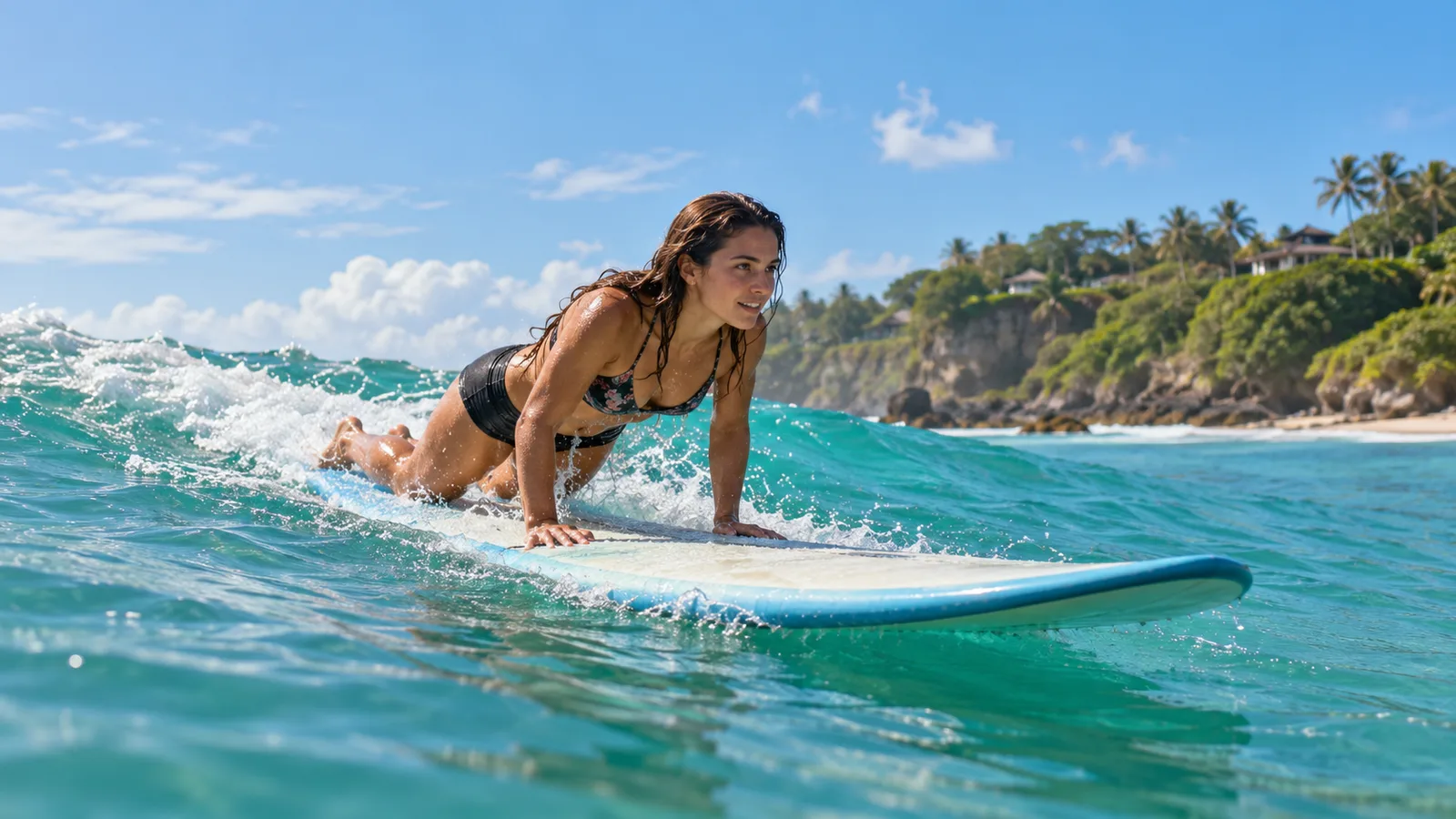
Standing up on a surfboard for the first time is the moment when surfing starts to make sense. Until then, you may spend most of a session paddling, falling, climbing back on the board and trying to understand the wave. Then, for a few seconds, everything comes together: the wave catches you, your feet move underneath your body and you are surfing.
The movement from lying on the board to standing is called the pop-up. It is one of the most important skills a beginner surfer learns. It is not a mysterious athletic trick. You can break it down, practise it on land and gradually make it feel natural.
The biggest beginner mistake is trying to stand up slowly from stomach to knees to feet. A pop-up should become a smooth, committed movement. Paddle into the wave, feel the board begin to glide, place your hands correctly, push your upper body up and bring your feet underneath you into a low stance.
Standing up is only one part of catching a first wave. Your position on the board, paddling, timing and choice of wave all matter. In Bali, choose conditions appropriate to your level rather than simply choosing the most famous wave in the area.
What is a surf pop-up and why is it important?
The pop-up connects paddling to riding a wave. You lie on your stomach, paddle to match the wave’s speed, feel the board glide and then transition to your feet. Your hands, upper body, feet and eyes all need to work together.
🏄 Board position
Lie close to the centre of the board. Too far forward and the nose may push into the water; too far back and the board becomes difficult to accelerate.
🌊 Wave timing
Begin the movement after the wave has started to pick up the board. Stand too early and you can lose momentum; wait too long and the opportunity can pass.
👐 Hand placement
Place both palms on the deck around the lower chest or ribs rather than grabbing the rails. This creates space for your legs to move underneath you.
🦵 Foot placement
Your feet should arrive under your body in a stable surf stance, not together or too close to the rails.
⚖️ Stay low and look forward
Finish with bent knees rather than straight legs. Looking down at your feet can pull you out of balance, so turn your head toward where you want to travel.
You can practise individual positions while learning, but the final pop-up should become one fluid movement rather than stomach, elbows, knees, one foot and then the other.
How to stand up on a surfboard: step by step
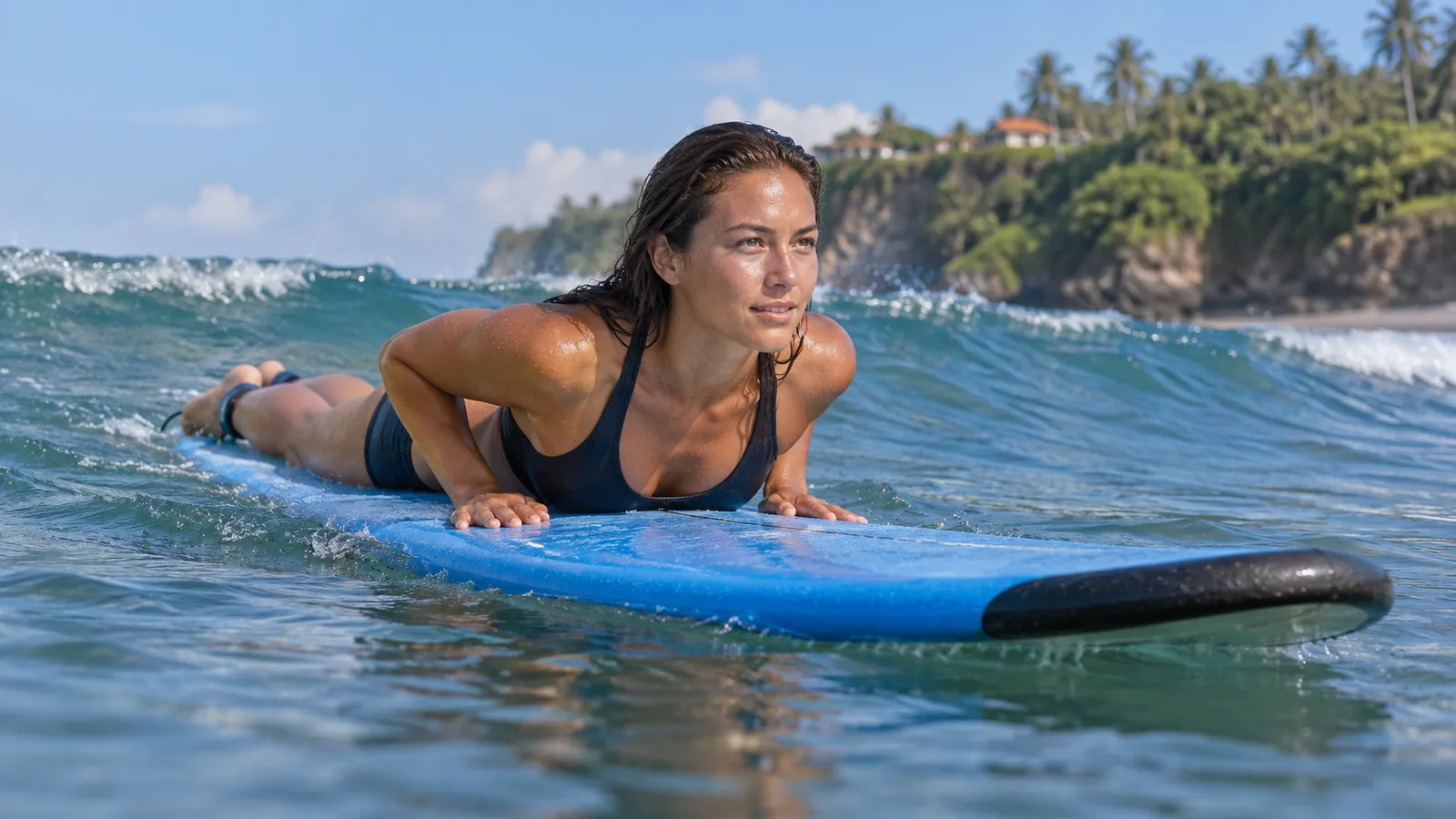
- Start in the paddling position. Lie on your stomach in the middle of the board, with your chest slightly lifted, head up and feet together. The board should sit relatively flat on the water.
- Place your hands beside your chest. Put your palms flat around the lower chest or rib area. Do not grab the rails.
- Push your upper body upward. Press firmly through your hands and lift your chest away from the board. Create space underneath your torso rather than performing a slow push-up.
- Bring your feet underneath your body. Move quickly into your surf stance. Do not make a slow detour through your knees once you have the strength and technique for a direct movement.
- Set your front and back foot. Your front foot lands around the board’s middle section; your back foot lands closer to the tail. Both feet should create a stable base across the board.
- Release your hands and stay low. Let go once your feet are under you. Keep your knees bent.
- Look where you want to go. Turn your head toward the open part of the wave, not down at your feet.
The movement may eventually take only a moment. First make the sequence technically correct; speed comes with repetition.
How to find your surfing stance: regular or goofy?
| Stance | Front foot | Back foot |
|---|---|---|
| Regular | Left | Right |
| Goofy | Right | Left |
Neither stance is better. Your stance is simply the position that feels natural for your body. If you skateboard or snowboard, you may already know it. Otherwise, practise pop-ups on a soft surface and notice which foot moves forward naturally. Try both several times, do not force a particular side, and ask an instructor to watch if you are unsure.
Keep your feet approximately shoulder-width apart, knees slightly bent and weight centred. The exact position changes with board size: a beginner on a large soft-top will not stand exactly like an experienced surfer on a shortboard.
What should you do when the wave comes?
Knowing how to pop up on land is only half the skill. In the water, beginners often stand before the wave has picked them up or wait until it has already passed beneath them.
Position → Paddle → Feel the wave → Commit → Pop up → Look ahead.
🌊 Position before the wave arrives
Do not wait until the final moment to think about where you are. An instructor can help you understand a suitable position for the conditions.
💪 Paddle to match the wave
Start paddling as the wave approaches. Timing and board position matter as much as effort.
🏄 Feel the board glide
Notice the moment the wave begins carrying the board rather than simply pushing water against it.
⚡ Commit and stay low
Once the board is moving with the wave, do not hesitate halfway through the pop-up. Look forward and keep your knees bent.
Small, controlled whitewater waves are an excellent place to learn. The aim is not to look impressive; it is to create successful repetitions until the movement becomes automatic.
Common pop-up mistakes
❌ Looking down at your feet
Looking down changes your body position and makes balance harder. Keep your head and eyes up.
❌ Going to your knees first
It can feel safer, but often slows the transition and makes it unstable. Work toward the direct movement from stomach to feet.
❌ Hands too far forward or gripping the rails
Your legs need space to come underneath you. Keep palms flat on the deck beside the chest.
❌ Feet too close together or posture too tall
A narrow stance and straight legs reduce stability. Land in a wider stance with bent knees.
❌ Standing too early or too late
Learn to feel the board glide before committing. A fast but uncontrolled pop-up is not better than a slightly slower, well-positioned one.
The most useful correction is simple: practise slowly on land, then make the movement faster only once it feels natural.
How to practise your pop-up before going in the water
Use a yoga mat, soft sand or a board on a soft surface. Start with several slow repetitions and focus on hand position, bringing your feet underneath you, finishing low and looking forward. Once the positions feel familiar, make the movement quicker without losing control.
Practising with a surfboard helps you understand the actual space available for hands and feet. Filming a side view can also reveal hands that are too far forward, a stance that is too tall or feet that land too close together. The difficult part is the transition from paddling to standing, so give that transition most of your attention.
Make your first surf session easier
🏄 Use a stable beginner board
A large soft-top or another board with sufficient volume gives you more stability and makes learning the pop-up easier.
🌊 Start with manageable waves
You do not need a powerful wave to learn to stand. Small waves create more opportunities to practise.
🛟 Choose appropriate conditions and instruction
A challenging wave does not accelerate learning. A good instructor can help with position, timing and technique while you concentrate on the pop-up.
🔁 Expect falls and measure repetitions
Falling is part of learning. A first ride may last only a few seconds and still be progress; the next goal is to repeat it more consistently.
If you are staying near Uluwatu, Surfside Bali can be a convenient base close to Suluban. Your first session, however, depends most on beginner-friendly equipment, appropriate waves, sound instruction and repeated practice.
What to remember before your first pop-up
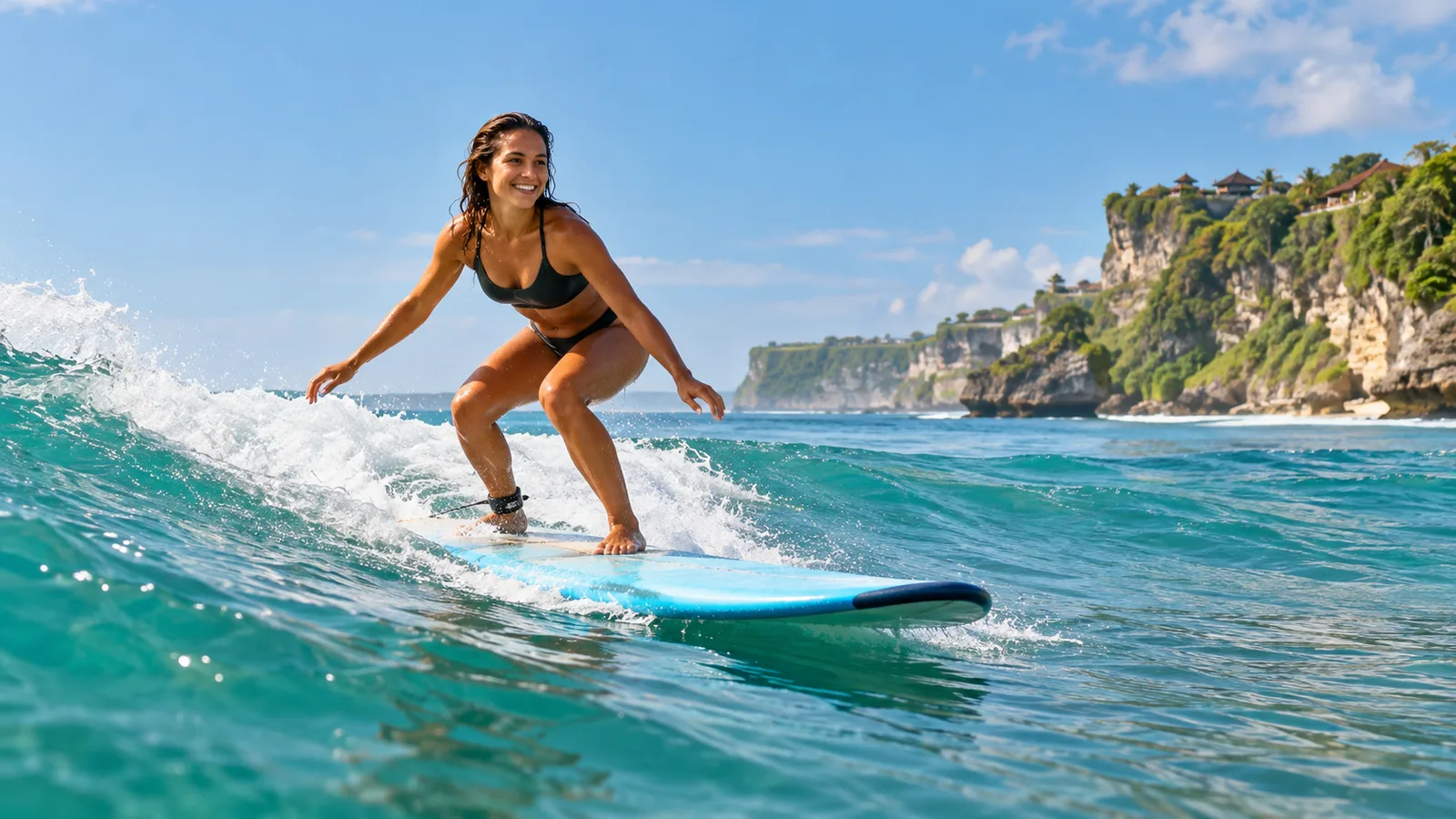
Lie correctly on the board. Place your hands beside your chest. Push your upper body up. Bring your feet underneath you. Land in a stable stance, bend your knees, look where you want to go and let the wave carry the board.
Your first successful stand does not need to be perfect. Learn the positions, connect them into one smooth movement, practise on land and give yourself enough repetitions to develop muscle memory. The first pop-up does not have to be perfect. It just has to get you standing.
Frequently asked questions
What is a surf pop-up?
A pop-up is the movement that takes a surfer from lying on the board while paddling to a stable standing position once the wave begins carrying the board.
Should beginners stand up on their knees first?
A direct movement from stomach to feet is the long-term goal. Beginners can practise the positions slowly, then develop a smooth pop-up as strength and coordination improve.
How do I know whether I am regular or goofy footed?
Try several pop-ups on land and notice which foot naturally moves forward. Regular means left foot forward; goofy means right foot forward.