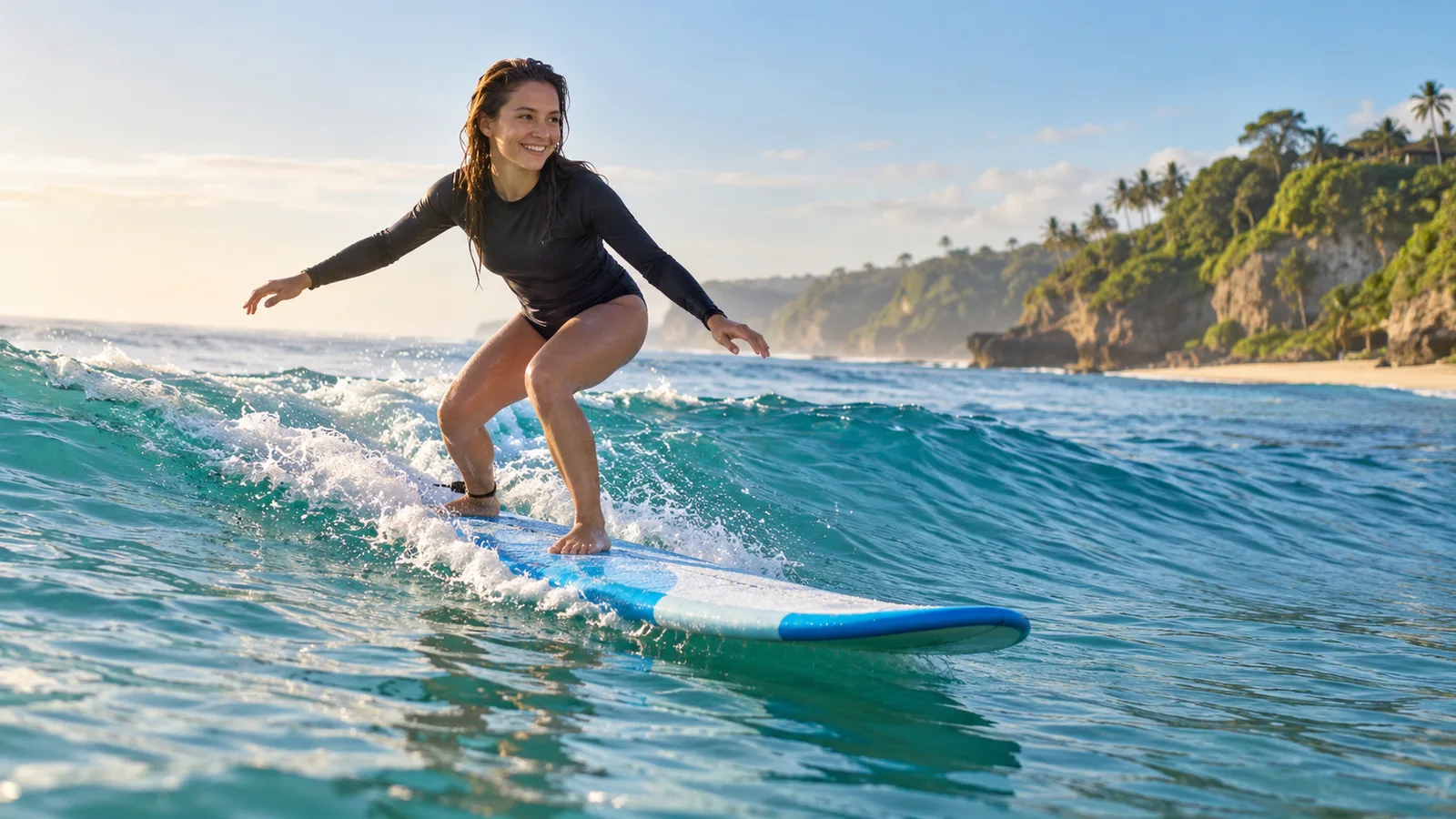
Choosing your first surfboard can be confusing. A surf shop may have longboards, shortboards, funboards, fish shapes, midlengths and soft-top boards in a wide range of sizes. For a beginner, it is easy to choose a board for its appearance rather than for what will make learning easier.
If you are looking for the best surfboard for beginners, your first board should make surfing easier, not harder. Stability, flotation and the ability to catch smaller waves matter more than speed or advanced manoeuvrability.
A board that is too small or too advanced makes it harder to paddle, catch waves and stand up consistently. Most people learning from scratch will progress more easily on a larger soft-top, longboard, mini-malibu or stable funboard than on a performance shortboard.
This is especially useful to understand when planning a surf trip to Bali. Uluwatu is one of the world’s best-known surfing areas, but not every wave or surf spot there is suitable for a beginner. Your board should match your present ability and the conditions you will actually surf.
What makes the best surfboard for beginners?
The best first board is not necessarily the board an experienced surfer would choose. Beginners are still learning how to paddle, position themselves, catch waves and maintain balance. A beginner-friendly board needs enough stability for mistakes and enough volume to float efficiently and catch waves with less effort.
🏄 High volume
Volume determines how much flotation the board provides. More volume generally makes it easier to paddle, remain stable and catch smaller waves. The suitable volume depends on your body weight, experience and the shape of the board.
↔️ Good width
A wider board gives you a larger, more stable platform. This matters when you are learning to stand and naturally making small balance corrections with your feet and body.
📏 Sufficient length
Longer boards provide more glide and make it easier to catch waves early. That is why longboards and larger soft-tops are common in beginner surf schools.
🧱 Forgiving construction
Soft-top boards have a foam-covered deck and a more forgiving construction during falls and early learning.
🌊 Easy wave catching
A beginner board should help you catch smaller, slower waves rather than require powerful, fast waves and highly precise positioning.
🛟 Stability
Stability is arguably the most important characteristic for a first board. A stable platform lets you focus on technique instead of constantly trying to stop the board from wobbling.
The goal is not to find the most advanced board you can physically stand on. It is to find a board that helps you catch more waves and get more practice during every session. A beginner who catches ten waves on a stable board has many more opportunities to learn than someone unsuccessfully trying to catch two waves on a high-performance shortboard.
Main types of surfboards and who they are for
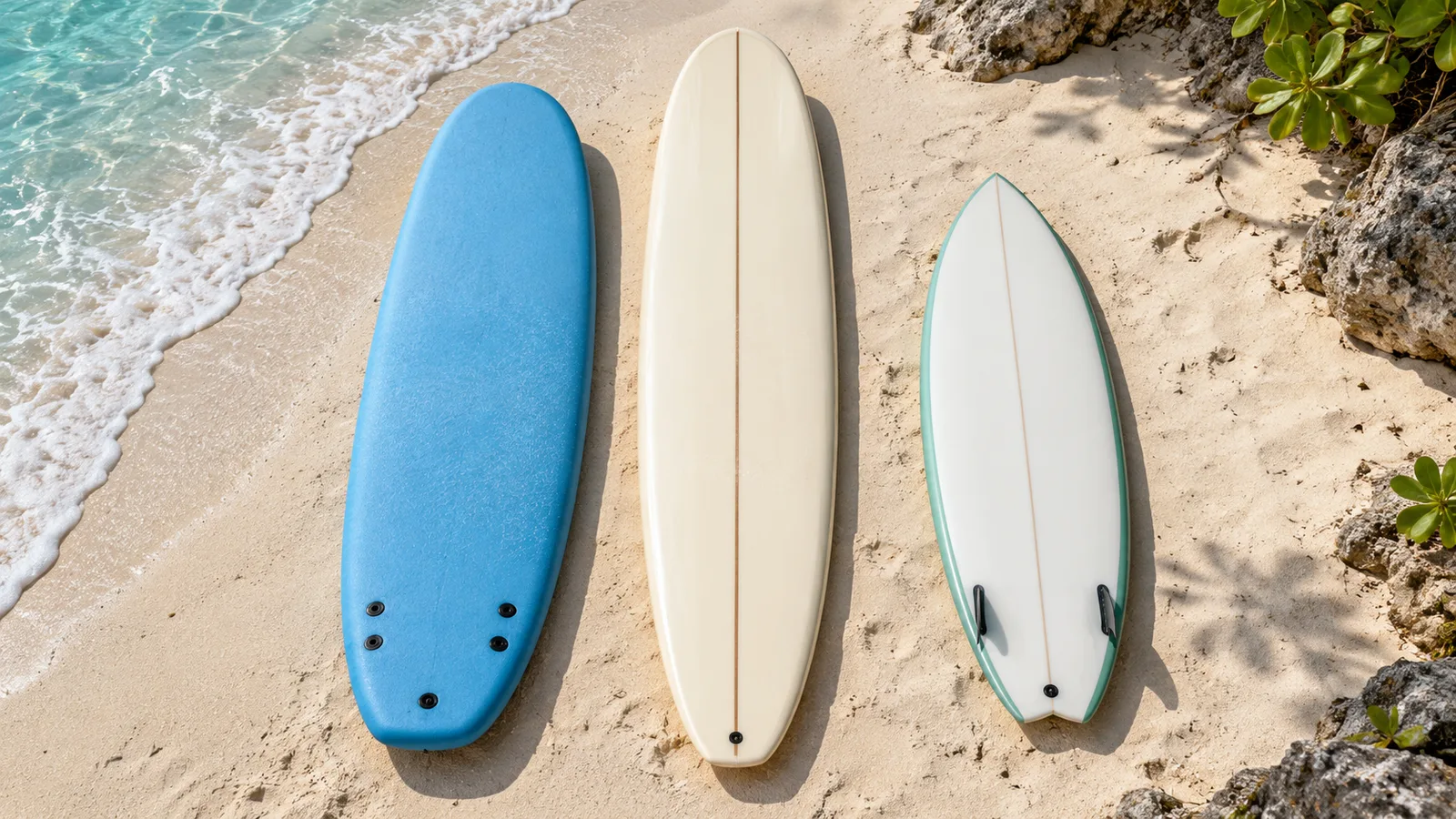
Surfboards are designed for different kinds of waves and different levels of ability. Understanding the main categories makes it easier to decide what is appropriate for your first sessions.
🟦 Soft-top surfboards
These are among the most beginner-friendly boards available. They are usually wide, stable and buoyant, and their soft deck makes falls more forgiving. Soft-tops are particularly common in surf schools and are an excellent choice for someone who has never surfed before.
🏄 Longboards
Longboards are generally around 9 feet or longer. Their length and volume provide excellent glide and stability, making them effective at catching smaller waves. A longboard can remain enjoyable after the beginner stage, so it is not necessarily a board you will quickly outgrow.
🟩 Funboards and mini-malibus
These boards sit between traditional longboards and shorter performance boards. They combine stability with manoeuvrability and can suit someone who has developed basic skills but still wants plenty of flotation.
🟨 Midlengths
Midlength boards provide paddle power and glide while being easier to manoeuvre than a traditional longboard. They often suit progressing surfers, though a sufficiently wide, high-volume midlength can work for some new surfers.
🟥 Shortboards
Shortboards are designed primarily for manoeuvrability and performance. They usually have less volume and require more precise positioning, stronger paddling and better balance. For most complete beginners, they are not the easiest place to start.
🐟 Fish boards
Fish shapes can work very well in certain small-wave conditions, but their shorter length and more specialised design do not automatically make them beginner-friendly. They are generally more appropriate once a surfer understands the basics.
For someone starting from zero, the most reliable options are usually a large soft-top, longboard or stable funboard. The best choice depends on your size, fitness, experience and the waves available where you intend to surf.
How to choose the right surfboard size
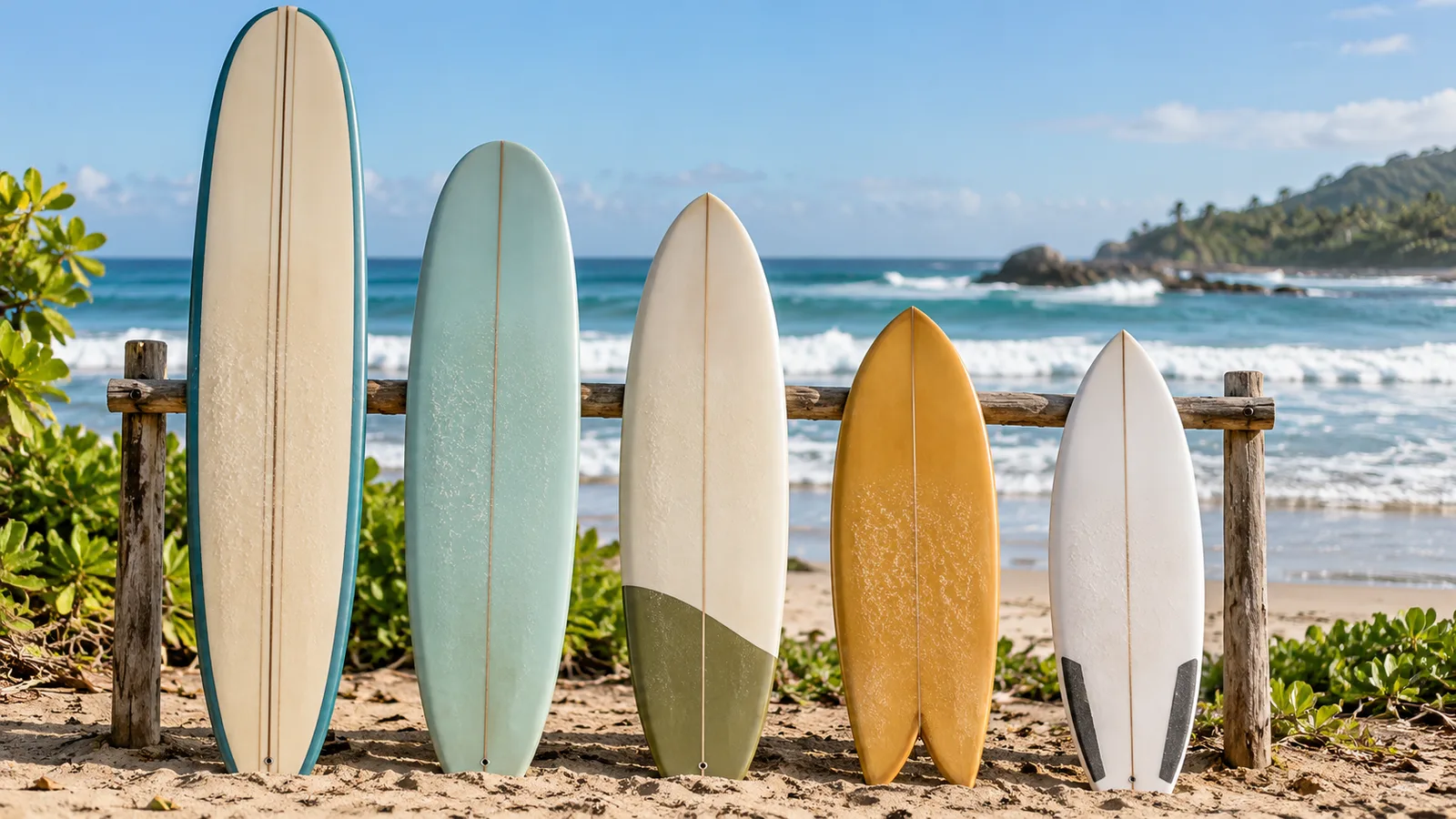
Choosing the correct size is not simply a matter of measuring a board from nose to tail. Two boards with the same length can feel completely different because of their width, thickness, outline and volume.
For beginners, volume is particularly important because it affects flotation. A board with insufficient volume can feel unstable and make paddling and wave catching much harder. Your body weight should be considered alongside your experience.
| Surfer profile | Suitable starting direction |
|---|---|
| Lightweight complete beginner | Stable soft-top or longboard with adequate volume |
| Average-weight complete beginner | Large soft-top, longboard or funboard |
| Heavier complete beginner | Wider board with higher volume and strong flotation |
| Beginner who can already stand consistently | Larger funboard, mini-malibu or suitable midlength |
| Progressing surfer | Gradually reduce volume as balance and technique improve |
These are general guidelines rather than strict rules. Board volume should always be considered with the board’s shape and the conditions where you will surf.
🧍 Reduced stability
A narrow board gives you less room to correct your balance when standing or moving your feet.
🌊 Harder wave entry
Low-volume boards require better positioning and paddling technique to catch waves consistently.
💪 More physical effort
You may spend considerably more energy paddling and trying to stabilise the board.
⏱️ Fewer opportunities to practise
If you miss most waves because the board is difficult to paddle, your learning process becomes slower.
📉 More frustration
Constantly falling can make surfing feel much harder than it needs to be.
Bigger is not always better. An extremely large board may be difficult to transport, carry through the water or control once you are more experienced. The aim is enough volume and stability for your current ability, while choosing a size that remains practical for your lifestyle and surfing conditions.
Soft-top, longboard or funboard: which is best for a beginner?

🟦 Choose a soft-top if you are starting from zero
A large soft-top provides a forgiving, stable platform for basic movements. It is especially useful during the first sessions, when falling is a normal part of learning.
🏄 Choose a longboard if catching waves easily is your priority
Its extra length and volume provide excellent glide. Longboards can remain fun after you develop basic skills, especially if you enjoy slower, more relaxed surfing.
🟩 Choose a funboard if you want stability and progression
A larger funboard can provide plenty of flotation while being easier to manoeuvre than a very long board. It can be a useful option after several lessons.
📈 Think about how quickly you are progressing
Someone already comfortable standing on a board may not need the same amount of stability as someone taking their first lesson.
📏 Consider transportation and storage
A 9-foot board can be excellent in the water but less convenient to carry, transport and store. A smaller funboard can offer a practical compromise.
💰 Consider renting before buying
If you are travelling, renting different boards helps you understand what works before investing in your own equipment.
🚫 Avoid choosing a shortboard simply because it looks advanced
A performance board may eventually be the right choice, but learning on one from day one can make basic skills much harder to develop.
The best first board is not necessarily the board you will use forever. It is the board that helps you develop the skills to eventually ride something smaller and more responsive.
Choosing a surfboard for Bali and Uluwatu
Bali is an exceptional destination for surfers because it offers a wide variety of waves and surfing environments. Choosing a surfboard for Bali does not mean choosing the same board for every surf spot.
Uluwatu is internationally famous for powerful reef breaks and high-quality waves, but many of its best-known breaks are not designed for someone taking a first surf lesson.
🌊 Match the actual wave conditions
Board choice should reflect the size, speed and power of waves you can realistically handle. A board suitable for a small beginner wave may not be appropriate in stronger surf.
📍 Choose the right surf spot
Do not assume the most famous break is automatically the best place to learn. Beginners should choose locations and conditions appropriate to their ability.
🏄 Be honest about your current skill level
A board that feels perfect after twenty sessions may be completely unsuitable during your first two.
🛟 Use safety and instruction
Equipment cannot compensate for conditions beyond your ability. Beginners should learn with appropriate supervision and local guidance.
⏰ Factor in timing
Tide, wind and swell can significantly change how a surf spot behaves. The same location can feel very different at different times of day.
📚 Ask for local advice
In Bali, instructors and experienced local surfers can offer useful information about suitable boards and conditions for your level.
If you are staying in Uluwatu, Surfside Bali can be a convenient base for a surf-focused trip, located close to Suluban. Accommodation is only one part of a good surf trip: your board, the conditions and your level all need to work together.
Should you buy or rent your first surfboard?
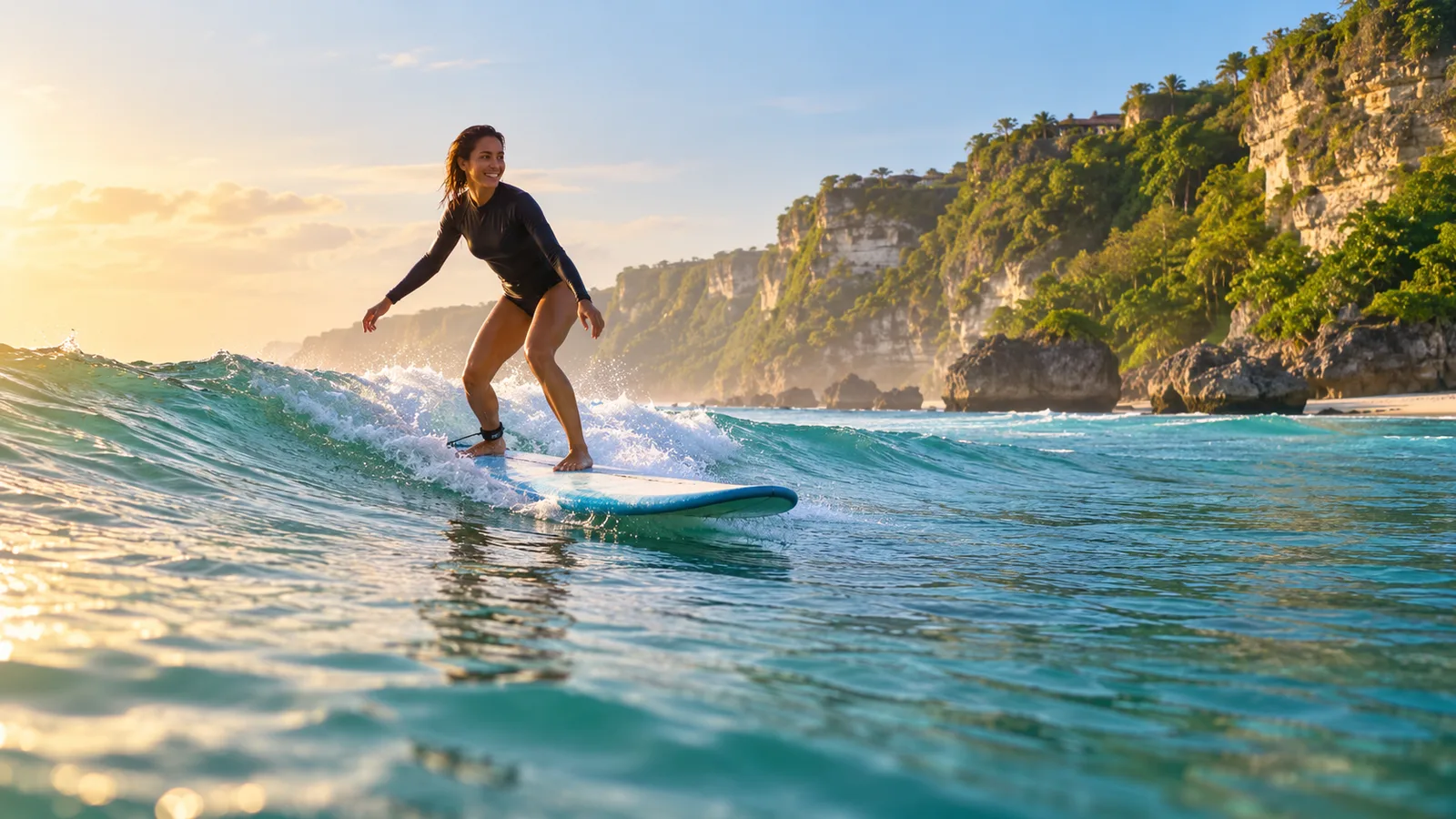
Buying immediately is not always the best decision, especially if you are completely new to surfing. Renting can be a practical way to discover what type of board suits your body, ability and preferred conditions.
🏄 Rent if you are a complete beginner
Your preferences can change quickly during the first sessions. A board that feels very large at first may soon become more comfortable as your balance improves.
🧪 Try different shapes
Renting a soft-top, longboard and funboard can help you understand the differences before purchasing.
💰 Consider transport costs
Taking a surfboard on a flight can involve extra logistics and baggage costs. Renting at your destination avoids those complications.
📅 Buy if you plan to surf regularly
If surfing becomes a long-term hobby and you expect to spend significant time in the water, owning a board can eventually make more sense.
📈 Buy after you understand your level
Once you can consistently catch waves, stand up and control direction, you will have a clearer idea of what kind of board you need.
🌴 Use Bali’s surf community
Bali has many opportunities to try different boards and get advice from experienced surfers and instructors.
For a short holiday, renting is often simplest. For a longer stay, buying a suitable second-hand beginner board can become more attractive. Do not rush a purchase: your first sessions are an opportunity to learn what equipment works for you.
Common mistakes when choosing a first surfboard
❌ Choosing a board that is too small
A short board may look exciting, but insufficient volume and width can make basic skills unnecessarily difficult.
❌ Looking only at length
Length matters, but width, thickness, outline and volume can completely change how stable a board feels.
❌ Buying for your future level
A board that is too difficult now can slow your progression, even if you hope to use it once you become advanced.
❌ Ignoring body weight
Board volume should be considered in relation to the surfer’s weight. A board that works for one person may be too small or too large for another.
❌ Copying an experienced surfer
A professional may use a very small board. That does not make the same board appropriate for someone learning the fundamentals.
❌ Choosing based on a famous surf spot
The board should match waves you can safely surf, rather than waves seen in professional videos.
❌ Ignoring practicality
A board can be excellent in the water but frustrating if it is difficult to carry, transport or store.
❌ Changing boards too quickly
Progress does not always mean moving onto a smaller board. Spending enough time on a stable board develops better paddling, positioning and balance.
Why the right first surfboard matters
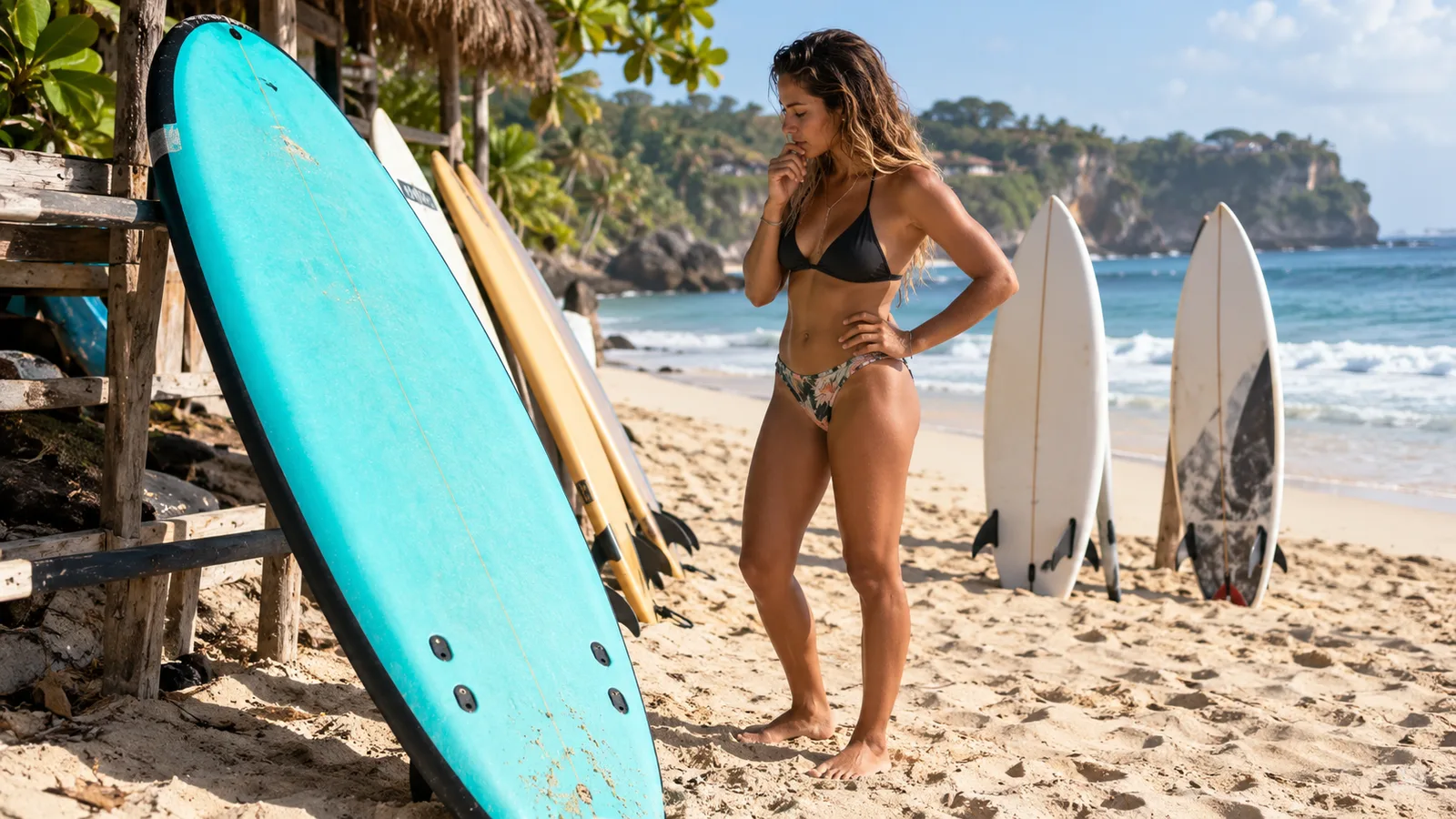
When searching for the best surfboard for beginners, it is easy to focus on brands, colours and specific model names. Those details matter more once you understand your preferences. For a beginner, start with stability, flotation, appropriate volume, sufficient width and a shape that makes catching waves relatively easy.
🏄 Catch more waves
More successful waves mean more opportunities to practise.
⚖️ Develop balance
A stable platform gives you time to learn how your body should move on the board.
🌊 Improve positioning
When the board is easy to paddle, you can focus on where and when to catch a wave.
💪 Build confidence
Early sessions should help you understand the basics rather than make surfing feel impossible.
📈 Progress naturally
Once your skills improve, move towards a smaller or more responsive board when your technique requires it.
For most complete beginners, a large soft-top, longboard or stable funboard with plenty of volume is the safest starting point. The exact choice depends on body weight, ability, the waves you intend to surf and whether you are learning through lessons or practising independently.
If your trip takes you to Uluwatu, a comfortable base close to the surf can make the experience easier. Ultimately, the best first surfboard is not the smallest, fastest or most impressive-looking board. It is the board that helps you catch waves, stay balanced, practise consistently and enjoy learning.
Frequently asked questions
What is the best surfboard for a complete beginner?
For most complete beginners, a large soft-top, longboard or stable funboard with enough volume is the easiest place to start.
Should a beginner buy a shortboard?
Usually not. A shortboard has less volume and stability, which can make paddling, catching waves and standing up harder during the first stages of learning.
Is it better to rent or buy a first surfboard?
Renting is often practical for a first surf trip because it lets you try different shapes before committing to a purchase.